
-
Clerks III (2022)
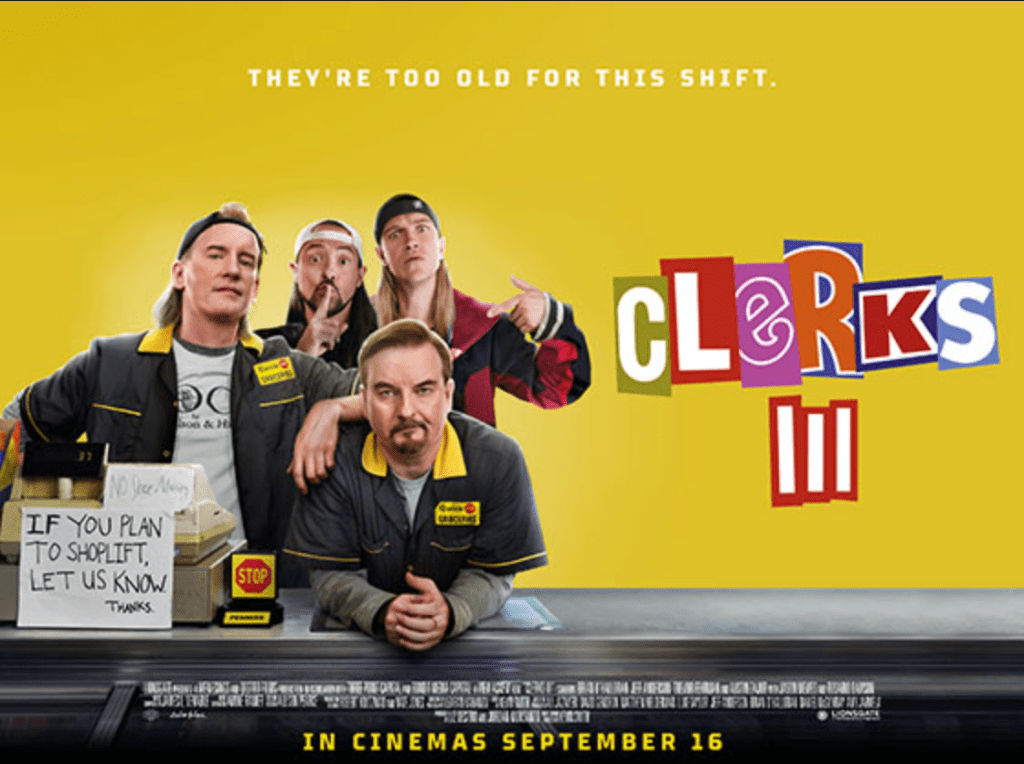
Clerks III (2022)
My personal list of favorite films have had the same top 3 movies on it since 2005. Number 1 is Ingmar Bergman’s The Seventh Seal. Number 2 is Billy Wilder’s Sunset Blvd.. And my third favorite film of all time is the 1994 classic comedy Clerks by Keven Smith.
The early part of Smith’s career is pure gold as you had Clerks, Chasing Amy, and Dogma, which I consider all three to be some of the best movies made in the 90s. He had this fresh pop culture take on every day things. It’s just a shame that society basically moved in on his territory, and now everyone talks pop culture all of the time. After Dogman, his movies really became hit and miss. Cop Out and Jersey Girl are quite bad. But Zack and Miri and Red State are fine movies. But his last few movies have been bad, and for only a single reason. It felt like Smith just didn’t have anything new to say. His last film Jay and Silent Bob Reboot doesn’t get interesting until the third act where he starts to explore Comic Con culture, but by that time it was impossible to salvage that movie.
So when I saw Clerks III was coming out, I was very very nervous. Growing up I related to the character of Dante Hicks, and I didn’t want Smith to ruin this part of this universe, he was able to make Clerks II pretty good, but I have just lost faith in him over the past few years. That being said, Clerks III isn’t terrible, it’s got some of Smith’s more annoying habits like putting all his friends in the movie. There’s a scene where the gang at the Quick Stop is holding acting auditions and we get cameos from everyone in Smith’s address book. The scene last for so long and it’s just not funny. And I wish he’d stop doing that in all his films.
The plot revolves around Randle who has a heart attack, and in the revelation that he hasn’t done jack with his life, decides to write a movie about 2 guys that work in a convenience store. And yeah, the movie does get meta, but in an interesting way. Characters and actors from the first movie come back to redo their roles, which gives the movie a sorta poignant nostalgia, an almost surreal feeling that hasn’t existed in any of his films before. But then again, there’s some wonky pacing, and some of the dialogue isn’t good, which is surprising because that’s Smith’s go too trick.
About halfway through the movie, I basically figured out where the movie was going. And for the last 30 minutes, I tired to mentally prepare myself for the movie climax. I was not prepared. When the climax hit, I sat in my seat with tears running down my cheeks, with snot rolling over my lips, I was crying like a blabbering little baby. And never in a thousand years would I have never expected Smith to make me cry, to make me get this emotional. But he did and that might be the biggest thing he’s ever done in the history of his career.
I’ve watched these characters form my teenage years onward, from Clerks, Clerks the animated series, Clerks II, and now Clerks III. And here’s to hoping this is the last chapter for the guys behind the counter.
-
100 Monsters (1968)
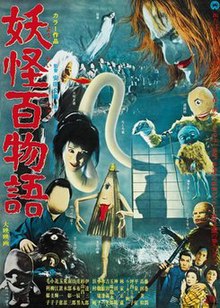
The things a samurai has to do for money. In this case, they gotta bust some ghosts. 100 Monsters is part of a series of yokai movies that focuses on monsters and samurai. It really is a strange mix of genres, but it’s a mix that’s mostly refreshing. But with a title like 100 Monsters, you’d think there would be at minimum 100 monsters in the film. So it’s kinda disappointing that the vast majority shows up in the last couple of scenes. But the monsters we get early on are incredibly cool.
You have the classic yokai umbrella monster, which really is quite a cute puppet that’s meant more as comic relief than terror. There’s a devious long headed monster, which is probably one of the best looking monsters of the 1960s. They use a lot of trick photography and puppetry to make it look like this lady’s head is extending like a snake. For example, the puppet neck stretches behind a pillar, and as the neck appears to wrap around the pillar, the actress’s face shows up, really making the illusion feel seamless. Today that effect would be CGI. But there’s just something magical about practical effects that makes a movie feel cinematic.
You have sword fights, you have monsters, which should be enough for any movie, but unfortunately for 100 Monsters they decide to add in an overly complex plot dealing with a landowner that scams a village and tears down their local shrine, thus the monsters. So the samurai, who may or may not be a ghost, has to help the village defeat the dirty landowner and his henchmen. It all gets a bit too busy and a bit messy. I just wanted to see the promised 100 monsters. But when they do show up, they are glorious as they take over the town.
-
Akira Kurosawa’s Dreams (1990)

September’s movie was David’s #12 Dreams… specifically Akira Kurosawa’s Dreams.
This seems to be something very different from anything I’ve ever seen from Kurosawa. It’s basically a compilation of 8 short films that he has labeled his dreams. I guess the closest of his films would be Rashomon, which has basically three shorts, but at least they are all the same plot just told from different perspectives. The shorts in Dreams are not connected at all. And you can tell this is one of his later films because of all the bright vibrant colors, probably his most vibrant movie since Ran.
I guess the best way to review this film is to talk about each segment, so here we go:
- Sunshine Through the Rain
A boy, presumably Kurosawa, interrupts a fox wedding during a rainstorm in the daylight. The boy’s mother says the foxes wants the boy dead and suggests he goes apologizes or commit seppuku for his transgressions. This is pretty out there. I think there’s a cultural barrier for a lot of these shorts that’s hard to overcome. More so than in any of his other more conventional narratives.
- The Peach Orchard
A boy follows a mysterious girl to a garden where the trees turn into living dolls. They give us a lecture on environmentalism and warn us there will be no more doll festivals if the peach orchards get chopped down. The only reason I know what a doll festival is, is because of an episode of Pokemon. Environmentalism is a theme throughout these shorts. - The Blizzard
A group of mountaineers get lost in a blizzard. They all die one by one as each is visited by a Yuki-onna, a strange old ghost woman which is again is another cultural entity that I wasn’t familiar with. It was nice seeing an attempt at horror from Kurosawa. winnable - The Tunnel
A discharged soldier is walking back home after WW2, when suddenly he is confronted by the dead men from his platoon. Now as far as I know, Kurosawa never served in his countries military. But he still did grow up during that WW2 era in Japan. This one ends up with soldier taking the blame for their deaths as he sent them to fight an un-winnable war.
- Crows
Here an art student gets lost in Van Gogh’s paintings, literally. He wanders from painting from painting as Kurosawa uses a lot of blue screen technology, which is kinda cool. And we get to see Marty Scorsese play Van Gogh, which is a good time. - Mount Fuji in Red
A nuclear power plant in Fuji is getting ready to blow. The people nearby have two choices, die from the radiation or drown themselves in the Ocean, all but four decided to stay out of the water and watch the world’s final moments. Kurosawa really hitting the themes of the environment hard. - The Weeping Demon
Now we are in a post apocalyptic world filled with giant vegetation and yokai like creatures. Kurosawa wonders this world and gets a brief history lesson from one of these monsters, one that seemingly is on the bottom of the food chain. - Village of the Watermills
Kurosawa visits a primitive town that only runs on the power of windmill. The town has forsaken all modern technology. There’s a funeral procession for a village elder, the town celebrates her life. This is one of the more cheerful dreams.
I would say that Kurosawa has more nightmares than dreams. It’s almost as if he’s constantly worried about the state of the world, haunted by the past, frightened of the future, terrified of how humanity will fuck up the world by cutting down forests, using unsafe means of power, and not respecting nature. I think most of these dreams are good, though they are a bit too short to truly appreciate. They are all beautifully shot, and it’s nice to see the old master embrace blue screen technology. But at the end I was left wanting more and wishing that he had been a bit more subtle in his themes. But I did enjoy the darker tone of a lot of these. It’s nice to see that even at the end of his career, Kurosawa was still trying to explore new areas of his art.
- Sunshine Through the Rain


