
-
Halloween Ends (2022)

It’s only fitting that Halloween Ends is the third installment in this trilogy, as it has more in common with the original Halloween 3 than any other Halloween movie. Halloween 3, for those that don’t recall, did not have Laurie Strode or Michael Myers in it, the plot revolved around an evil Irishman wanting to turn children’s heads into mush by way of evil Halloween masks. In Halloween Ends, we get Laurie and Michael, but they take a backseat to Laurie’s granddaughter and this movie’s new protagonist Corey.
And I guess David Gordon Green wanted to do something “different”, I mean how many times can you make a slasher movie fresh. How many times can Laurie come face to face with the bogeyman. This movie starts out more like John Carpenter’s Christine as opposed to a Halloween movie, but instead of a killer car you get an old serial killer. You get a nerd that gets bullied into becoming a serial killer, followed by some questions about evil being inherent or is it created. Jamie Lee Curtis is just kinda in the background watching things happen, pretty much like in Halloween Kills where she was stuck in a hospital bed the entire time. And her granddaughter, Andi Matichak, becomes the love interest of this new Corey guy.
And that’s a shame that the first movie started out with strong female characters, and now they play a secondary role, almost as if Green was trying to subvert his own thematic threads. Like the first movie was about Laurie’s trauma from 1978, and now we are less concerned with her and more focused on abstract questions on the nature of evil.
This movie isn’t all bad. I will say the first 10 minutes are quite good. And the final fight is over the top and fun to a degree. But overall Halloween Ends is a bad movie, but it’s a different kind of bad than Halloween Kills. With Kills I watched it twice in a row because it was comically bad. Ends however is boring bad, and that in some ways is worse. By the end I was left wondering if the Corey stuff would have worked as its own movie if you would have taken all the Halloween elements out of it. But as of right now, I’m not even sure if Ends can even be considered a Halloween movie. Just set it up on the shelf next to Halloween 3 as an oddity to the massive, never ending, franchise.
-
The Reflecting Skin (1990)
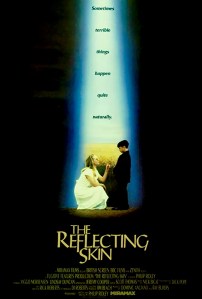
The Reflecting Skin is an incredibly different kind of vampire movie. It has the sensibilities of a David Lynch movie and the visual aesthetic of Andrew Wyeth. There’s hand painted fields of golden wheat, dust covered gravel roads, and barns that are tilted askew. It is a weird movie, it is a dark movie, and it is an unpleasant movie that explores the nightmares of middle rural America through the eyes of a 9 year old child.
The movie starts out with three little kids blowing air into a frog and exploding it in the face of the local weird British lady. Soon the children suspect that the odd young lady is a vampire. She doesn’t like to look into mirrors, she tells the children that she’s 200 years old, and she keeps her dead husband’s hair and teeth in a box. Soon the children of the town start getting murdered, and young Seth Dove tries to understand and piece together what darkness covers this town.
The movie shares a lot of similarities with David Lynch’s Blue Velvet, especially its senes of hyperrealism. There’s a lot of weirdness in the movie. A lot of it, especially early on, as we have a father that stinks of gasoline, a mother that is overly neurotic, and a mysterious slick black car with leather clad men that look like Elvis and James Dean. But there’s also some things that weird just for the sake of being weird. There’s a set of twins that carry a dead chicken down the road, Seth finds an aborted fetus that he thinks is an angel, and there’s a scene where Seth’s mother forces him to drink an ungodly amount of water as a punishment.
The fetus, I found to be particularly disturbing. The deaths of the children are disturbing. Everything in the movie is disturbing. It paints a desolate world that has no hope. And having such a nightmarish pessimistic view point, leads to a sad and unfulfilling ending.
-
The Hourglass Sanatorium (1973)
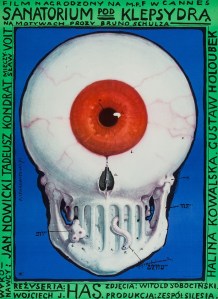
Bruno Schulz was a surrealist writer and artist in Poland in the 1930s. He was also Jewish. And being a Jew in Poland during the height of Nazism ended up causing his death, as he was gunned down in a Jewish ghetto for no reason other than two bickering Gestapo officers needing to take their anger out on someone. His last works didn’t survive the war, but at least his early collection of short stories were published before shit went down in Europe.
In 1971 Polish filmmaker Wojciech Jerzy Has attempted at adapting Schulz’s poetic dreamlike shorts. This lead to the creation of The Hourglass Sanatorium one of the most disjointing movies that I have ever seen, and I’ve seen a lot of crazy incoherent stuff. The story follows a young Jewish man, Joseph, that’s on his way to visit his dead(?) father at an unnamed sanatorium. The movie starts off in one of the strangest trains ever made as the walls look like a train, the set rocks back and forth like a train, but the train car is way to big and it has house furniture instead of regular train seats. It’s all very disorienting.
Joseph gets to the sanatorium and discover that time works different there, and that his father is slightly less dead than he thought. What unfolds is a Kafka-esque menagerie as Jospeh is forced to confront his past and his family as doorways randomly takes him across the world and into the past. He tries to escape one room by crawling under a bed and when he comes out the other side, he’s face to face with an elephant in Africa. When Jospeh does find himself in the past, his behavior starts to change as he becomes more childlike. I wish they would have made an American adaptation of, because I kept thinking Robin Williams would have been perfect for this type of film.
But alas, Joseph goes from scenario to scenario, from phantasmagoria to phantasmagoria getting into trouble running from soldiers and leading a resistance with an army of wax mannequins. But we also get to see a Jewish ghetto, possibly one that resembled what Schultz experienced in his last days. The movie overall reminded me a lot of Kafka’s The Trial, a world of poetic delirium that is too abstract to properly describe, it can only be experienced.
An interesting aside, the film was banned by the communist Polish leadership. It had to be smuggled out of the country to screen at the Cannes Film Festival. This cost Has his career as he basically was blacklisted in his country for a decade.


