
-
Pride and Prejudice (1995)

I am part of a monthly movie exchange group where we recommend movies to a randomly chosen member. This month I was recommended Pride and Prejudice… the long version…. I mean really long…. 6 episodes long…. I could have been tracking down the Golden Globe nominees, but no, I had to watch Colin Firth sexily dive into a pond so he could show off his well formed body for the ladies. And all of this is so weird because towards the start of this year, I was tasked with watching the 2005 version of Pride and Prejudice. So it’s Déjà vu all over again.
I will say that this miniseries is fine. Equally as good as the feature. But it’s odd, because I don’t know what exactly the feature cut out. Which that leads me to question why the did this need to span over 6 hours. The mini series and the movie start off the same way, where we aren’t given proper introductions to the family. A box full of young horny Bennet sisters is thrown at us and we are left to our own devices to sort them out. I’m curious if the book starts out in such chaos. But the Bennet’s of this version don’t seem as friendly with one another as in the feature. Which is a shame, since I liked that heart warming broken family dynamic. Plus the mother in the mini series is so loud, so annoying, she is my least favorite character. I hate her. But maybe that’s the point.
After the opening, I started to realize the one big difference. And that is in the production design. Now, I do believe that the mini series and the feature are set in slightly different time periods. But the aesthetics in the feature along with the lighting looks super crips and interesting, while the miniseries has this hue of dull green kinda washed over it. It just didn’t feel as alive. In fact, it felt very British. And the quality of the episodes were hit and miss. The chaos in the first episode made it feel like the pacing was going too fast. But then episode two hit, with the introduction of preacher/cousin, who is my favorite character as he adds some much needed laughs to all the Britishness.
The acting is basically on par with the acting in the feature. Jennifer Ehle has a slightly more subtle take on Liz Bennet, which is much welcome considering that she gets 6 hours to have an arc. Firth though, as Mr. Darcy, is leagues better than Matthew Macfadyen. Macfadyen had the charisma of a piece of white bread. Firth on the other had is charming and arrogant and curious and so on and so on. He really brings out the range of emotions going on in Darcy’s head. May I say, that even I might would have fallen for this version of Mr. Darcy.
Like I said, everything is fine, the pacing is a bit odd as the choices for commercial breaks seemed forced at times. The acting is good, the scene is nice, and the story is alright, except the ending, which still bothers me. Mr Wickham never really gets his just desserts. And I think that really rubbed me the wrong way in this version as he stands out as even more of a wicked pedophilic money grabber. Does anything bad happen to him in the book? God I hope so.
-
Avatar: The Way of Water (2022)
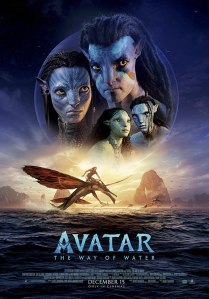
The only reason for the Avatar sequel to exist is as a toy, as a way for James Cameron to continue playing in the water as he has done for the last 30 years. All he wants is a reason to work on new technologies, which would be admirable, except that it’s a self indulgent venture. It would have been different if Cameron actually had a story that he wanted to tell. But instead we get more cultural appropriation, more PSA style thematics – instead of Save The Rainforest, it’s now Save The Whales -, and more liquid thin character and plot development. The movie is 3 hours and 12 minutes of drivel.
Me and Avatar 2 got to a very bad start. I wasn’t a fan of the first movie, but at least I understood its appeal for those who need their cinema to be spectacle. Everyone needs a sugary treat every now and again. Back in 2009, I still wasn’t sold on the visuals; James Cameron’s blue man group still looked like CGI rag dolls swinging in the wind. And yeah, it borrowed heavily from Dances with Wolves and Pocahontas… and that’s fine as it was a coherent story.
So I had little interest in seeing The Way of Water in the first place. But then I made the big mistake of seeing it in 3D with HFR. And for those of you that don’t know, HFR stands for High Frame Rate. Movies are usually shot at 24ish frames a second. You get 24 pictures that run through a projector every second. Movies have been shot this way for almost a century now. There’s been filmmakers in the past that have experimented with HFR, The Hobbit movies were shot in 60 fps, trying to eliminate all sense of motion blur, trying to mimic how our eyes perceives real life. Cameron obviously realized how awkward those movies looked, so he made the decision to shoot Avatar at variable frame rates. Most of the movie is at 24 fps, while certain scenes, mainly action sequences and underwater sequences, are shot at 40 fps. This causes those sequences to look and feel like a video game cut scene. They looked awful and silly, and distracted from the movie, especially whenever a 24 fps shot is randomly inserted into those 40 fps scenes.
But the rest of the CGI and the creatures that have been created for the movie are indeed stunning, They are beautiful to look at, but they aren’t, in themselves, stimulating or mentally engaging. I might as well have been looking at a computer’s screen saver for 3 hours. The plot, stupefyingly, is able to steal arcs from Cameron’s other films, there’s a bit of Terminator mixed with a dash of Titanic, and a whole lot of The Abyss thrown in to make things very moist Plus there’s a whole Moby Dick subplot as we spend at least 15 minutes watching humans go whaling.
Now I could go on about the plot, how the blue main characters from the first movie have to flee to a village of aqua blue people as they are hunted down by the same bad guy from the first film. But the plot felt like it was almost an afterthought, as you could predict the beats 30 minutes before they happen. It’s inconsequential… as is most of the movie.
-
Nanny (2022)
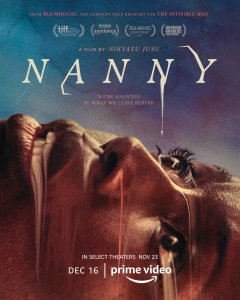
In the last 5 years we have experienced a renaissance in the Black horror genre, coinciding with the rise of director Jordan Peele and his social thrillers Get Out and Us. There has been a surge of new minority voices in Hollywood that have been confronting white audiences with the horrors and reality of what it’s like to be black in America. Nikyatu Jusu is one of these new voices whose directorial debut, Nanny, releases into select theaters this week and begins streaming on Amazon Prime on December 16th.
I caught Nanny during this year’s Filmland event, and out of the half dozen movies I watched during the festival, Nanny was by far my favorite of the bunch. I went into the movie knowing literally nothing about It, other than the fact that it premiered at Sundance, won the Grand Jury Prize, and was picked up by Amazon Studios and Blumhouse Productions for distribution.
The movie focuses on a Senegalese immigrant, Aisha (Anna Diop), who has recently been hired by a well-to-do, Upper East Side white family to work as a personal nanny for their young and finicky daughter, Rose (Rose Decker). Soon, Aisha finds herself submerged, drowning with the pressures of working in the white domestic household as more and more is asked from her. She works long hours, suffers sleepless nights, and has to constantly remind the family to pay her on time. The only reason she puts up with these transgressions is because she is saving up money to bring her own child and her sister to the country. But the pursuit of this American Dream just might lead Aisha down an ominous path as she begins to lose her sense of self and is crushed by the weight of her own maternal sacrifice.
So far, Nanny might sound more like a domestic drama rather than a scary flick, but the horrors of the movie manifest themselves in the form of African folklore in what can only be described as a really, really slow burn. The first 30 minutes of the film build up a tone of dread as it’s hinted that the Aisha’s employers might have more sinister ambitions. But then we are introduced to Anansi the Spider, a West African folk legend, who is a rogue mischief maker and trickster. One night, young Rose tells Aisha that the invisible spider is talking to her and telling her to do bad things. It’s at this point where the movie starts delving into a more surrealistic horror with scenes that are hauntingly disorienting.
Nanny is a dark, claustrophobic film, but one that is rich with style and gorgeous symbolic imagery. It’s shot with a slick, keen eye by cinematographer Rina Yang, as she bathes the penthouse apartment in shadows of blue, not letting us see what lurks in the dark corners of rooms. Jusu certainly has a clear vision for her film, which is rather rare for first time writer/directors. But having such a clear visual sense of her subtext and themes does cause a bit of a challenge for the overall screenplay, as the pacing suffers a bit and is sacrificed for the movie’s imagery. The movie takes its time to really kick into gear, and for the first act, you’re really not sure what direction the movie is headed, which could prove frustrating to some audience members. But once the plot and the scares start, you remain invested in Aisha’s plight as her life and mental state spiral out of control, leading to an emotional gut-punch of a climax in the final minutes of the movie.
There’s also a subplot that feels like it could have been integrated into the film smoother: Aisha finds a romantic interest in the doorman, Malik (Sinqua Walls), at the building she’s working in. Their relationship is a nice addition to the movie that gets Aisha out of the dreadful house and gives her glimpses of happiness and normalcy. The subplot also helps the movie provide some context and backstory to the African folklore as Malik’s grandmother–an expert on the subject–gives the audience some much needed exposition.
However, the inconsistent pacing can be forgiven by the top notch acting from the relatively unknown cast. Anna Diop, who had a minor role in Us, plays Aisha with such conviction and strength that, when the walls start closing in on the immigrant, it’s heartbreaking to see her crack. Michelle Monaghan plays Rose’s mother, Amy. She is a peculiar character as she almost resents Aisha for being more of a mother figure to Rose than she is.The scenes between Monaghan and Diop are expertly done; there’s this silent, awkward tension between the two women that sucks all the air out of the room.
Nanny isn’t perfect, but by first feature standards, it is a great achievement for Jusu, who gives the audience lots to ponder about as it explores themes of race, gender, class, culture, and motherhood, all of which are themes that can be quite haunting in the dark.


