
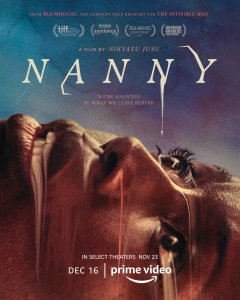
In the last 5 years we have experienced a renaissance in the Black horror genre, coinciding with the rise of director Jordan Peele and his social thrillers Get Out and Us. There has been a surge of new minority voices in Hollywood that have been confronting white audiences with the horrors and reality of what it’s like to be black in America. Nikyatu Jusu is one of these new voices whose directorial debut, Nanny, releases into select theaters this week and begins streaming on Amazon Prime on December 16th.
I caught Nanny during this year’s Filmland event, and out of the half dozen movies I watched during the festival, Nanny was by far my favorite of the bunch. I went into the movie knowing literally nothing about It, other than the fact that it premiered at Sundance, won the Grand Jury Prize, and was picked up by Amazon Studios and Blumhouse Productions for distribution.
The movie focuses on a Senegalese immigrant, Aisha (Anna Diop), who has recently been hired by a well-to-do, Upper East Side white family to work as a personal nanny for their young and finicky daughter, Rose (Rose Decker). Soon, Aisha finds herself submerged, drowning with the pressures of working in the white domestic household as more and more is asked from her. She works long hours, suffers sleepless nights, and has to constantly remind the family to pay her on time. The only reason she puts up with these transgressions is because she is saving up money to bring her own child and her sister to the country. But the pursuit of this American Dream just might lead Aisha down an ominous path as she begins to lose her sense of self and is crushed by the weight of her own maternal sacrifice.
So far, Nanny might sound more like a domestic drama rather than a scary flick, but the horrors of the movie manifest themselves in the form of African folklore in what can only be described as a really, really slow burn. The first 30 minutes of the film build up a tone of dread as it’s hinted that the Aisha’s employers might have more sinister ambitions. But then we are introduced to Anansi the Spider, a West African folk legend, who is a rogue mischief maker and trickster. One night, young Rose tells Aisha that the invisible spider is talking to her and telling her to do bad things. It’s at this point where the movie starts delving into a more surrealistic horror with scenes that are hauntingly disorienting.
Nanny is a dark, claustrophobic film, but one that is rich with style and gorgeous symbolic imagery. It’s shot with a slick, keen eye by cinematographer Rina Yang, as she bathes the penthouse apartment in shadows of blue, not letting us see what lurks in the dark corners of rooms. Jusu certainly has a clear vision for her film, which is rather rare for first time writer/directors. But having such a clear visual sense of her subtext and themes does cause a bit of a challenge for the overall screenplay, as the pacing suffers a bit and is sacrificed for the movie’s imagery. The movie takes its time to really kick into gear, and for the first act, you’re really not sure what direction the movie is headed, which could prove frustrating to some audience members. But once the plot and the scares start, you remain invested in Aisha’s plight as her life and mental state spiral out of control, leading to an emotional gut-punch of a climax in the final minutes of the movie.
There’s also a subplot that feels like it could have been integrated into the film smoother: Aisha finds a romantic interest in the doorman, Malik (Sinqua Walls), at the building she’s working in. Their relationship is a nice addition to the movie that gets Aisha out of the dreadful house and gives her glimpses of happiness and normalcy. The subplot also helps the movie provide some context and backstory to the African folklore as Malik’s grandmother–an expert on the subject–gives the audience some much needed exposition.
However, the inconsistent pacing can be forgiven by the top notch acting from the relatively unknown cast. Anna Diop, who had a minor role in Us, plays Aisha with such conviction and strength that, when the walls start closing in on the immigrant, it’s heartbreaking to see her crack. Michelle Monaghan plays Rose’s mother, Amy. She is a peculiar character as she almost resents Aisha for being more of a mother figure to Rose than she is.The scenes between Monaghan and Diop are expertly done; there’s this silent, awkward tension between the two women that sucks all the air out of the room.
Nanny isn’t perfect, but by first feature standards, it is a great achievement for Jusu, who gives the audience lots to ponder about as it explores themes of race, gender, class, culture, and motherhood, all of which are themes that can be quite haunting in the dark.


Leave a comment