
Bruno Schulz was a surrealist writer and artist in Poland in the 1930s. He was also Jewish. And being a Jew in Poland during the height of Nazism ended up causing his death, as he was gunned down in a Jewish ghetto for no reason other than two bickering Gestapo officers needing to take their anger out on someone. His last works didn’t survive the war, but at least his early collection of short stories were published before shit went down in Europe.
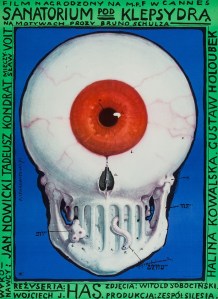
In 1971 Polish filmmaker Wojciech Jerzy Has attempted at adapting Schulz’s poetic dreamlike shorts. This lead to the creation of The Hourglass Sanatorium one of the most disjointing movies that I have ever seen, and I’ve seen a lot of crazy incoherent stuff. The story follows a young Jewish man, Joseph, that’s on his way to visit his dead(?) father at an unnamed sanatorium. The movie starts off in one of the strangest trains ever made as the walls look like a train, the set rocks back and forth like a train, but the train car is way to big and it has house furniture instead of regular train seats. It’s all very disorienting.
Joseph gets to the sanatorium and discover that time works different there, and that his father is slightly less dead than he thought. What unfolds is a Kafka-esque menagerie as Jospeh is forced to confront his past and his family as doorways randomly takes him across the world and into the past. He tries to escape one room by crawling under a bed and when he comes out the other side, he’s face to face with an elephant in Africa. When Jospeh does find himself in the past, his behavior starts to change as he becomes more childlike. I wish they would have made an American adaptation of, because I kept thinking Robin Williams would have been perfect for this type of film.
But alas, Joseph goes from scenario to scenario, from phantasmagoria to phantasmagoria getting into trouble running from soldiers and leading a resistance with an army of wax mannequins. But we also get to see a Jewish ghetto, possibly one that resembled what Schultz experienced in his last days. The movie overall reminded me a lot of Kafka’s The Trial, a world of poetic delirium that is too abstract to properly describe, it can only be experienced.
An interesting aside, the film was banned by the communist Polish leadership. It had to be smuggled out of the country to screen at the Cannes Film Festival. This cost Has his career as he basically was blacklisted in his country for a decade.


Leave a comment